Government Taking Steps to Introduce Constitutional Amendments: Tilvin Silva
08-Sep-2026.
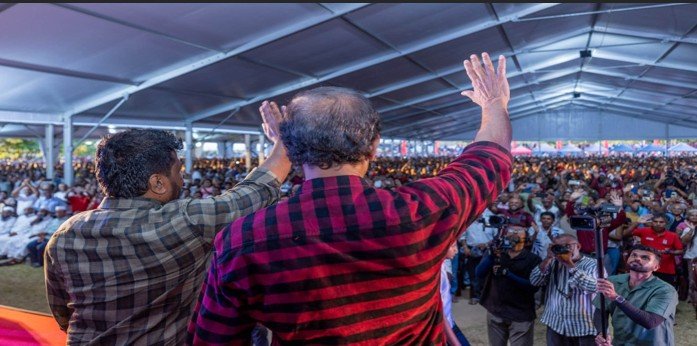
The Government is taking steps to introduce constitutional amendments to strengthen the country’s judiciary, reduce delays and costs associated with court cases faced by the public, and ensure the speedy delivery of justice, Janatha Vimukthi Peramuna (JVP) General Secretary Tilvin Silva said.
He also said the arrests and court cases currently being pursued were not acts of political revenge.
The second public meeting of President Anura Kumara Dissanayake’s nationwide public outreach programme, held under the theme “Two Years in Office – Glory to the Country”, took place in the Beruwala area of the Kalutara District on September 6.
Addressing the gathering, Silva said the Government was seeking to introduce constitutional amendments with the objective of strengthening the judiciary and ensuring faster justice by reducing delays and costs faced by the public.
He claimed that those who had introduced the 18th Amendment in the past to extend their political power and indefinitely prolong the presidential term, and those who had further increased executive powers through the 20th Amendment, were now attempting to label the present Government as authoritarian.
He also criticised those who had brought an impeachment motion against former Chief Justice Shirani Bandaranayake in Parliament and removed her from office, saying that those who had violated democracy and engaged in protests and stone-throwing outside judges’ residences were now attempting to lecture others on democracy.
Silva said the NPP was a movement that had understood the importance of rights and democracy through its own struggles and that it regarded democracy as addressing the needs and grievances of the people rather than serving the interests of rulers.
He said the arrests and court proceedings currently being carried out were not politically motivated.
Instead, he said independent institutions such as the Criminal Investigation Department and the Commission to Investigate Allegations of Bribery or Corruption were conducting proper investigations, gathering evidence and submitting them to court, while the Government had not interfered in the process.
He said it was the courts that decided whether suspects should be remanded or released on bail.
By contrast, he alleged that during the previous administrations associated with Mahinda Rajapaksa, political opponents had not been dealt with through legal means and that journalists such as Lasantha Wickrematunge and Prageeth Eknaligoda had been killed or abducted, while media institutions had been set on fire.
“That history is known to the entire country,” he said.
Silva further claimed that the NPP had the distinction of being the first political force in Sri Lankan history to celebrate victories at a Presidential Election and a General Election peacefully, without incidents of violence or killings.
He said no one had been harassed or subjected to violence during the celebrations and that the Government had introduced a democratic political culture that could serve as an example to future generations.
He said the NPP’s rise to power was not merely a victory for a political party, but an expression of the long-standing aspirations of ordinary people who had been marginalised for decades and were seeking change.
Therefore, he said, the Government did not belong solely to a particular political movement but to all citizens of the country.
Silva stressed that the role of voters did not end after electing a government.
Under the conventional political culture, he said, people voted, selected their rulers and then remained silent, often believing that their responsibility ended after pointing out shortcomings.
However, he said the present approach was different and emphasised that citizens had an equal role, alongside the Government, in building the country.
While the Government was responsible for implementing programmes, he said, citizens also had a responsibility to provide their fullest cooperation.
He therefore called on the public to fully support programmes such as ‘Clean Sri Lanka’ and village-level development initiatives currently being implemented.
“Making the country clean and disciplined is not solely the responsibility of the Government; it is the responsibility of every individual,” he said.