22nd Constitutional Amendment Bill Passed with Two-Thirds Majority
26-Sep-2026.
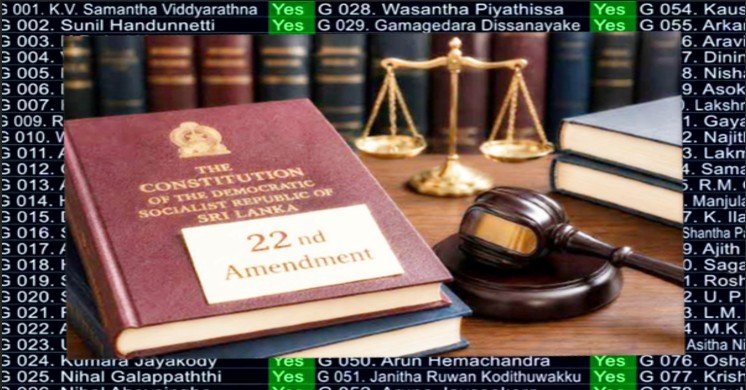
The 22nd Constitutional Amendment Bill and the Judicial Amendment Bill, which had recently faced considerable controversy and criticism, as well as strong opposition from sections including the judiciary and the Opposition, were passed by Parliament with the required two-thirds majority.
At the vote held in Parliament on 25 September 2026 on the 22nd Constitutional Amendment Bill, 158 Members voted in favour and 63 against. The Bill was accordingly passed with a two-thirds majority, with a majority of 95 votes.
The 22nd Constitutional Amendment Bill and the Judicial Amendment Bill, which seek to increase the retirement age of justices and judges, were presented to Parliament by the Minister of Justice on 18 August amid strong opposition from the Opposition.
Following this, petitions were filed before the Supreme Court by various parties seeking an order that a referendum, in addition to a two-thirds majority in Parliament, would be required for the passage of the 22nd Amendment Bill.
Accordingly, 67 petitions were filed before the court, and the hearings were conducted before a five-member bench headed by the Chief Justice. The hearings of the petitions concluded on the 2nd.
Thereafter, the Supreme Court’s determination regarding the constitutional validity of the 22nd Constitutional Amendment Bill was communicated to the Speaker, and the Speaker announced the court’s determination in Parliament on the 22nd.
The Speaker stated that the court had determined that, under Article 83 of the Constitution, the 22nd Amendment Bill, or any part thereof, did not require approval by the people at a referendum and could be passed by Parliament with a two-thirds majority.
Meanwhile, the Speaker also informed the House that the provisions of the Judicial Amendment Bill were not inconsistent with the Constitution and that the Bill could therefore be passed by a simple majority in Parliament.
Following this, a two-day debate on the two Bills was held on the 24th and 25th. Finally, at around 7.10 p.m., when the Speaker presiding over the sitting asked the House whether it wished to approve the 22nd Amendment Bill, Minister Nalinda Jayatissa, the Government Chief Whip, called for a vote.
Accordingly, the quorum bell was rung and the vote was conducted at 7.15 p.m.
During the subsequent electronic vote on the 22nd Constitutional Amendment Bill, all Members of the ruling National People’s Power voted in favour. The Bill received 158 votes in support.
Meanwhile, 63 Members, including Members of the Samagi Jana Balawegaya, parties affiliated with the Samagi Jana Balawegaya alliance, the Sri Lanka Podujana Peramuna, the United National Party, the New Democratic Front, the Ilankai Tamil Arasu Kadchi, the Tamil National People’s Front, the Democratic Tamil National Alliance, Labour Party Members and independent group Member Arjuna, voted against the Bill.
Accordingly, the Bill was passed with a two-thirds majority, with 95 more votes in favour than against.
Similarly, during the vote on the Judicial Amendment Bill, all Members of the ruling National People’s Power voted in favour. The Bill received 158 votes in support.
A total of 63 Members, including Members of the Samagi Jana Balawegaya, parties affiliated with the Samagi Jana Balawegaya alliance, the Sri Lanka Podujana Peramuna, the United National Party, the New Democratic Front, the Ilankai Tamil Arasu Kadchi, the Tamil National People’s Front, the Democratic Tamil National Alliance and independent group Member Arjuna, voted against the Bill.
Accordingly, the Judicial Amendment Bill was also passed with a majority of 95 votes.
Meanwhile, Ravi Karunanayake and Faizer Musthapha of the New Democratic Front, and Nayan Wasalathilaka of the Samagi Jana Balawegaya, did not participate in the votes on either the 22nd Amendment Bill or the Judicial Amendment Bill.