People have every right to criticise and protest against the Government, says President
14-Nov-2026.
Organised, disciplined and forward-looking protests conducted to address people's grievances would benefit both the country and the Government. However, protests without clear objectives or proper organisation could create anarchy and cause serious harm to the public and the country, President Anura Kumara Dissanayake said.
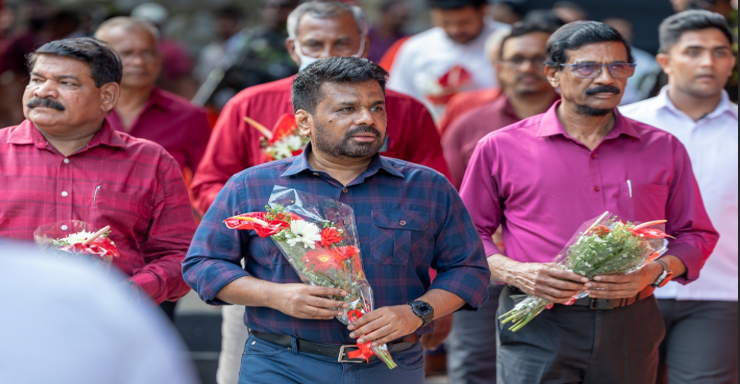
He was addressing the 37th November Heroes' Commemoration held at the Viharamahadevi Open Air Theatre in Colombo on 13 November 2026, in memory of the deceased members of the Janatha Vimukthi Peramuna (JVP), including its founder Rohana Wijeweera.
JVP General Secretary Tilvin Silva, party leaders, ministers representing the National People's Power (NPP), and members of both political organisations attended the event.
Addressing the gathering, the President said:
"If protests are to take place in this country, they must be conducted in an organised, disciplined and forward-looking manner. Such protests are beneficial to the country as well as to the Government. We have never considered them wrong.
"For instance, when the Government implements an agricultural policy, farmers may feel that the policy adversely affects their interests. If so, there is nothing wrong with farmers joining together through their organisations and conducting an organised protest. Farmers have their own organisations, clear objectives, a long-term vision and discipline. Such protests do not cause harm to the country.
"However, protests that lack discipline, organisation, objectives, purpose and direction are harmful to the country. Ultimately, they create anarchy.
"When we observe the protests emerging in different parts of the country, people begin to wonder what might happen the following day. On one occasion, someone undertakes a hunger strike unto death. On another occasion, someone takes sticks and starts wielding them. We must seriously consider what kind of situation these actions are intended to create.
"An anarchic situation in which nobody can predict what might happen the following day is harmful to the country. Therefore, although we support the people's right to criticise the Government, such criticism and protests must be guided by a long-term vision, proper organisation and discipline.
"People have every right to criticise the Government and conduct protests against it. However, activities whose consequences for the country and its people cannot be anticipated cannot simply be described as protests. Such actions are capable of creating anarchy.
"People must therefore remain vigilant against political trends that could push the country towards anarchy. The National People's Power and the Janatha Vimukthi Peramuna must function as organised political movements capable of intervening to prevent such developments.
"We cannot allow such anarchic situations to emerge in our villages. Before coming to power, we carried out extensive political activities across villages. We established women's organisations, youth organisations, farmers' associations and various other groups to bring people together. We engaged in social and political activities with a long-term vision for the future of the country.
"However, after assuming power, there have been occasions when we have set aside political activities and confined ourselves largely to State administrative functions. This is not the correct approach.
"There is a separate administrative structure for governing the country. Government activities are carried out through the public administration system, extending from the President's Secretary to the Grama Niladhari. We must obtain the views, participation and contributions of the people to ensure that this administrative machinery functions in their interests.
"At the same time, another important responsibility entrusted to us is to continue our political engagement with the people beyond the functions of public administration. In particular, we must initiate new political discussions at village level.
"As part of this effort, we previously organised a series of public meetings attended by thousands of people. We are continuing our efforts to organise similar meetings in the future and bring people together through organised political engagement.
"At present, the political forces opposing the Government have become weakened. This weakness has placed them in a difficult position and created frustration. Frustration affects one's ability to remain composed. When composure is lost, the possibility of engaging in inappropriate activities increases.
"Weakness leads to helplessness. Helplessness creates frustration. Frustration leads to unrest, and unrest can result in uncontrolled behaviour. This is the nature of the political situation that has emerged among the forces opposing us.
"Nevertheless, we are confident that our political movement, which has a much longer history and stronger experience than these weak and anarchic protest movements, will overcome such challenges and move forward while safeguarding this Government, our administration and our political ideology.
"The responsibility entrusted to us today is entirely different from the responsibilities we had in the past. We have faced numerous challenges, including building the party, confronting political struggles, resisting repression, contesting elections and enduring periods during which the party was banned.
"During the past 60 years, nearly 59 years of our political activities were largely devoted to the struggle to secure State power. Today, we have assumed power. Therefore, we must redefine our challenges and responsibilities in accordance with the objectives we have undertaken to fulfil.
"For this purpose, we must think differently from the past and adapt ourselves to the new circumstances. We must move forward with the determination and capacity to overcome emerging challenges.
"Previously, much of our sense of responsibility in political activities was directed towards the party itself. We had opportunities to resolve internal problems, discuss shortcomings, identify areas requiring change and implement necessary reforms.
"However, the situation has changed since we assumed the responsibility of governing the country. Our foremost responsibility and obligation are now towards the people. We must be accountable for every incident arising from the functioning of the Government. We cannot evade responsibility by claiming that previous administrations failed to fulfil their obligations.
"We must be accountable to the people living in this country today. They have given us a mandate and entrusted us with the responsibility of forming a Government. Therefore, we have an obligation to answer to them.
"We have local government institutions, their chairpersons, ministers, elected representatives and the public administration structures associated with them. Every action, decision and statement made by us must therefore be accountable to the people.
"Our activities, decisions, public statements and conduct must be carried out with a greater sense of responsibility than before. Previously, much of our responsibility was towards the party. Today, the greater part of our responsibility is towards the people.
"We must establish a political culture based on accountability to the public. People have every right to criticise us, question us and organise protests against us. We have undertaken the responsibility of working for their welfare, and we must respect that responsibility.
"In the past, the political culture in this country was one in which people lived in fear of those in power. Villagers were afraid of the chairman of the Pradeshiya Sabha. People in the surrounding areas feared members of the Pradeshiya Sabha. Communities were afraid of ministers. The relationship between those in power and the people was based on fear and submission.
"We must change this relationship. The new relationship we seek to establish must enable people to question those in power, criticise them and organise protests against their actions.
"We must create this new political culture. Our intention is not to intimidate people or force them into submission. Rather, we want to create a society in which people can question those in power and openly criticise their actions.
"At the same time, such criticism must remain within the standards of conduct expected in a civilised society. While ensuring freedom to criticise, question and express opinions, we must also safeguard the values and standards of a civilised community.
"Some people ask us why we allow others to use abusive language against us. Let them criticise us as much as they wish. However, people will not accept defamatory remarks and insults that fall below the standards of a civilised society.
"Therefore, while establishing a new relationship between the Government and the people, we must also bring about changes in the country's economy and political system. We have already begun the journey towards achieving these changes.
"Since its formation in the 1960s, our political movement has experienced numerous historical turning points and challenges. In 1971, we faced severe repression. Many who helped build our party were killed, while others were imprisoned.
"In 1978, we re-entered the political arena. We contested by-elections, local government elections and presidential elections. Subsequently, the party was banned once again, and we faced further repression. During that period, several of our leaders, including Rohana Wijeweera and Gamanayake, were killed.
"In 1994, we returned to active politics and, following a long political journey, secured State power in 2024.
"We faced one type of challenge when contesting elections, another when the party was banned, and yet another when continuing political activities from within prisons. Today, we face an entirely different set of challenges in governing the country.
"Despite all these changes, the fundamental characteristics that have held our political movement together have remained unchanged. We have not abandoned our ability to withstand criticism, repression and imprisonment, our sense of collective responsibility or our close relationship with the people.
"For any political movement to move forward, it must maintain a strong relationship with the people. We must give priority to listening to them, working alongside them and understanding their way of life and the problems they face.
"We maintained our relationship with the people even during periods of political conflict, imprisonment and organisational weakness. Now that we have secured State power, we must strengthen that relationship further.
"Today's political achievement is the result of a journey undertaken over more than six decades by several generations who dedicated their lives to a common objective and endured numerous challenges and hardships.
"We must properly understand the new challenges and responsibilities that have emerged after assuming power and move forward by overcoming them. We must work together to fulfil these responsibilities," the President said.