Death penalty for drug offences discussed at National Council chaired by President
11-Aug-2026.
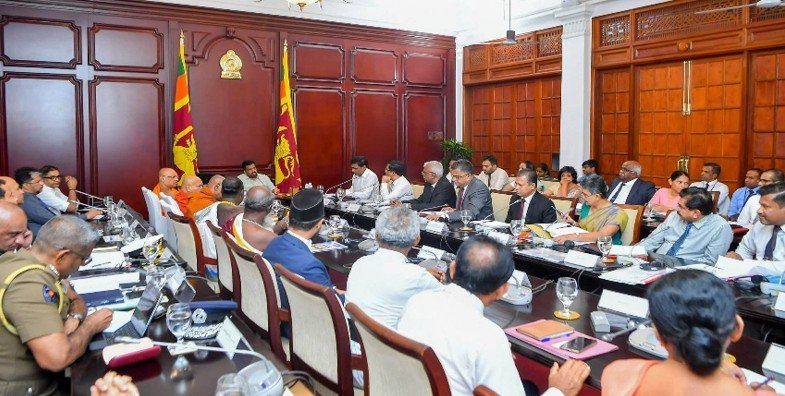
The possibility of imposing the death penalty for drug-related offences was among the matters discussed at the “Whole Country as One” National Action Council.
President Anura Kumara Dissanayake instructed the relevant authorities to submit accurate data classifications based on the quantities of drugs seized, in order to expedite legal proceedings involving persons in custody due to delays in reports issued by the Government Analyst.
He also instructed that proper coordination be established among the Government Analyst’s Department, the police and the prison authorities, and that a system be introduced to produce suspects before court immediately after the relevant analytical reports are received.
The matter was discussed when the “Whole Country as One” National Action Council met at the Presidential Secretariat on August 10, 2026, under the chairmanship of President Anura Kumara Dissanayake.
The issue has received attention in view of the fact that the threat posed by dangerous drugs has now gone beyond individual relationships and has become a serious threat to the country’s entire economic and social system, while continuing to expand.
The criminal environment created around the enormous wealth generated through drug trafficking has become a major threat to the national economy, tourism industry and social values, it was noted.
The Presidential Media Division said the council discussed the need to implement strict laws to build a society that is free from fear of drug trafficking and related crimes.
President Dissanayake stressed the need for practical action and rapid attitudinal change within the country to eradicate the drug menace, which is disrupting the entire social system and placing the future generation at risk. He said the Government expected the active involvement of religious leaders, parents and community organisations in this effort.
The meeting also held an extensive discussion on institutional changes that need to be introduced after taking into consideration the magnitude of this national crisis.
It was noted that amendments to laws relating to drug control and bail have already been prepared and are at the final stage. These amendments are expected to be gazetted shortly and presented to Parliament.
The process of issuing Government Analyst’s reports, which had been identified as a major reason for delays in drug-related cases, has been significantly expedited. It was revealed that 6,414 reports had been issued in July alone.
In order to expedite legal proceedings involving persons in custody due to delays in Government Analyst’s reports, the President instructed officials to submit accurate data classifications based on the quantity of drugs seized, including categories such as less than five grams and less than 10 grams.
He also instructed the authorities to establish proper coordination among the Government Analyst’s Department, the police and prison authorities and introduce a system to produce suspects before court immediately after the relevant reports are received.
The President inquired about measures being taken to increase the capacity of the Government Analyst’s Department and expand its facilities. It was also revealed that steps had been taken to obtain the assistance of the Navy in transporting samples for analysis.
The President further instructed that funds be allocated for the installation of security camera systems.