Committee to Review Prison Regulations Applicable to Buddhist Monks, Says President
09-Oct-2026.
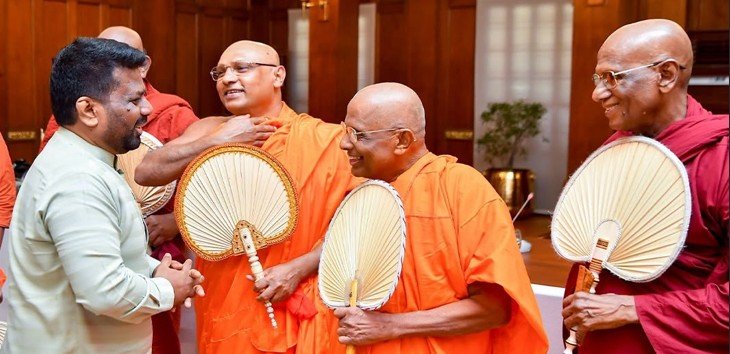
President Anura Kumara Dissanayake has announced that a committee will be appointed to review existing laws, regulations and standing orders governing the detention of Buddhist monks in prisons and their transportation outside prison premises, and to recommend necessary amendments.
The President also emphasised that he would never permit special orders to be issued at his personal discretion for the benefit of an individual, thereby allowing his personal wishes to become law.
He made these remarks during a meeting with members of the Maha Sangha representing the Mahanayake Theras of Sri Lanka’s three Buddhist monastic chapters at the Presidential Secretariat in Colombo on 8 October 2026.
Those present included Most Ven. Narampanawa Ananda Thera, Anunayake of the Asgiri Chapter of the Siam Nikaya; Most Ven. Pahamune Sri Sumangala Thera, Chief Secretary of the Malwathu Chapter; Most Ven. Mahawela Sri Ratanapala Thera, Deputy Chief Secretary of the same chapter; Most Ven. Balapitiye Siriseewali Thera, Chief Secretary of the Sri Lanka Amarapura Maha Nikaya; Most Ven. Ahangama Maitrimurthi Thera, Deputy Chief Secretary of that Nikaya; Venerable Aththangane Sasanarathana Thera, Chief Secretary of the Sri Lanka Ramanna Maha Nikaya; and Most Ven. Kongasthenne Ananda Thera.
Minister of Buddhasasana, Religious and Cultural Affairs Dr Hiniduma Sunil Senevi and Minister of Justice and National Integration, Attorney-at-Law Harshana Nanayakkara, also attended.
The meeting included an extensive discussion of matters raised in a letter sent by the Mahanayake Theras to the Commissioner-General of Prisons concerning the appearance of Galagodaaththe Gnanasara Thera in court without his saffron robes, among other related issues.
The President said that existing laws and regulations governing how Buddhist monks are detained in prison and transported outside prison premises needed to be reviewed.
“I intend to appoint a committee comprising representatives of the Attorney General’s Department, the Ministry of Justice, the Ministry of Public Administration, the Ministry of Buddhasasana, Religious and Cultural Affairs, prison officials and the Commissioner-General of Prisons, among other relevant parties. The committee must conduct its review and submit the necessary recommendations within two weeks,” he said.
He added that provisions applicable to Buddhist monks should be revised in consultation with the Maha Sangha.
“I am not prepared to disregard existing laws and issue orders according to my personal wishes for the benefit of an individual. If a law has become outdated, it must be amended through the proper legislative process. I will not allow my personal wishes to become law,” he stressed.
The President explained that the present prison system operated under the Prisons Ordinance enacted in 1877. The legislation had been amended from time to time, and Section 94 empowered the minister to make regulations. Prison regulations were also amended in 2022. The Commissioner-General of Prisons, subject to ministerial approval, had the authority to issue standing orders.
He observed that the existing regulations had largely been formulated with ordinary prisoners in mind. Specific provisions concerning Buddhist monks appeared in Regulation 216.
Prisoners were broadly classified into two categories: remand prisoners and convicted prisoners. The issue under discussion did not arise in the case of monks held on remand but became relevant after a monk had been convicted.
The President further explained that imprisonment could involve either rigorous imprisonment or imprisonment under other penal provisions. Prisoners serving sentences other than rigorous imprisonment could choose their clothing with the approval of the prison superintendent. Those sentenced to rigorous imprisonment, however, were required to wear the prescribed prison uniform.
Referring to the letter sent by the Mahanayake Theras, he said the issue was not limited to the manner in which monks were detained inside prisons. It also arose whenever they were taken outside prison premises, including for court appearances, where they could be seen by the media and the public.
“I have also examined the circumstances concerning the 63 religious figures currently in prison. Some monks have to appear before courts in other cases while already serving sentences in one case. In such circumstances, some monks have previously appeared in court without their saffron robes,” he said.
The President noted that prison officials had acted in accordance with the laws and regulations currently in force and that blaming them alone would serve no purpose.
At the same time, he acknowledged that it was understandable for Buddhists and members of the Maha Sangha to feel shocked or surprised when a monk whom they had previously venerated was seen in a different appearance.
“Laws do not have to remain unchanged forever. Laws that are no longer appropriate to the times must be amended. Any new regulations must not target an individual monk. They must apply generally to the entire prison system,” he said.
The President suggested that special arrangements for monks might not have been adequately developed because their imprisonment had not previously been anticipated to the same extent.
“Monks, too, have been affected by the deterioration that has emerged in society. Clear new regulations are therefore necessary regarding how monks are detained in prison and transported outside prison premises,” he added.
The Maha Sangha thanked the President for his initiative and offered its blessings for prompt action to resolve the issue.