“We do not have a Provincial Council of our own”: Hill Country parties tell Indian Foreign Secretary Vikram Misri
07-Aug-2026.
Tamil Progressive Alliance (TPA) Leader and Parliamentarian Mano Ganesan said that several key issues, including the forthcoming Provincial Council elections, the drafting of a new Constitution, the political aspirations of Hill Country Tamil people regarding power-sharing, the 13th Amendment, the executive presidency and devolution of power, were highlighted during discussions with Indian Foreign Secretary Vikram Misri.
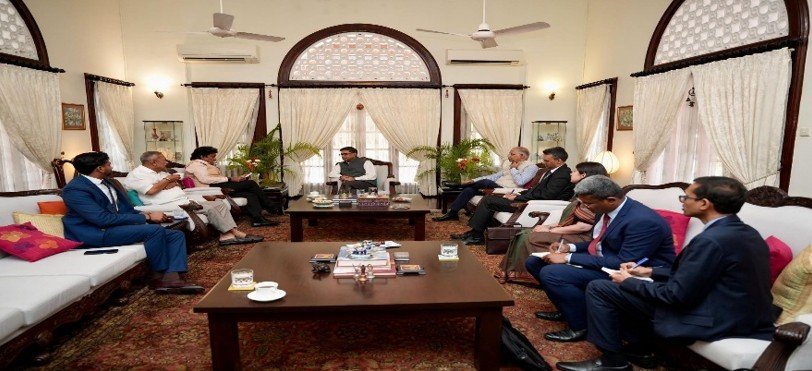
A delegation comprising representatives of the Tamil Progressive Alliance and Hill Country Tamil representatives met Indian Foreign Secretary Vikram Misri, who was on an official visit to Sri Lanka, at India House in Colombo on August 5.
The meeting was attended by TPA Leader Mano Ganesan, Deputy Leader and Parliamentarian V. Radhakrishnan, and Ceylon Workers’ Congress General Secretary and Parliamentarian Jeevan Thondaman. Indian High Commissioner to Sri Lanka Santosh Jha, officials from the Indian Ministry of External Affairs and representatives of the Indian High Commission in Sri Lanka also participated.
Speaking about the meeting, Mano Ganesan stated:
“We informed Indian Foreign Secretary Vikram Misri, on behalf of the Tamil Progressive Alliance, that the Indian-origin Hill Country Tamil community living in Sri Lanka is looking forward to the Provincial Council elections to be conducted by President Anura Kumara Dissanayake and the discussions on a new Constitution, in order to fulfil their national and regional political aspirations relating to power-sharing.
Regarding the new Constitution discussions, we clarified India’s legitimate concern over whether the proposed Constitution could become an opportunity to abolish the Provincial Council system currently provided for under the Constitution.
During the previous good governance administration, although the constitutional reform process was not completed, we had reached the stage of an interim report. Therefore, President Anura Kumara Dissanayake had stated that if he became President, the new discussions would commence from the positions reached up to that interim report, rather than restarting the entire process from the beginning. This is a positive development.
The interim report had proposed strengthening the 13th Amendment and the Provincial Council system contained in the present Constitution. Therefore, although India’s concerns were understandable, they are no longer necessary at present. We informed the Indian Government that we believe President Anura Kumara Dissanayake will fulfil his commitment.
Similarly, with regard to the Indian-origin Hill Country Tamil people who live dispersed across nearly 12 to 13 districts in Sri Lanka, we pointed out that we do not have a Provincial Council where we constitute a majority and can have our own Chief Minister.
Therefore, based on the internationally recognised principle of non-territorial political power-sharing for communities living in a dispersed manner, we informed Mr. Misri that the Tamil Progressive Alliance is prepared to present a new proposal for a ‘non-territorial community council’ during discussions on the new Constitution.
We also informed him that the Tamil Progressive Alliance has never supported the complete abolition of the executive presidential system in the proposed new Constitution. During previous constitutional discussions, our position was that a limited executive presidency, with reduced powers and accountable to Parliament, but elected by the people of the entire country, should continue.
When there is a President elected by all citizens and responsible to the entire country, that President is compelled to address the aspirations, needs and demands of smaller Tamil-speaking minority communities during elections and in between elections. Our issues receive national-level attention.
We also informed the Indian Foreign Secretary that although President Anura Kumara Dissanayake has a positive outlook towards Tamil-speaking communities and relations with India, several members within his Government and party hold negative views.
In particular, we brought to India’s attention that certain Tamil representatives affiliated with the present Government have ridiculed and undermined discussions between President Dissanayake and Tamil representatives regarding the political aspirations of Tamil-speaking people, and have ignored the engagement initiated by their own party leader and the country’s President.
Therefore, we warned the Indian Government that if obstacles arise in securing the legitimate aspirations of the people we represent through the elected Government, such difficulties would not arise from us or President Anura Kumara Dissanayake, but from Tamil politicians within the Government,” he said.