491 skeletons identified from Chemmani mass grave
07-Aug-2026.
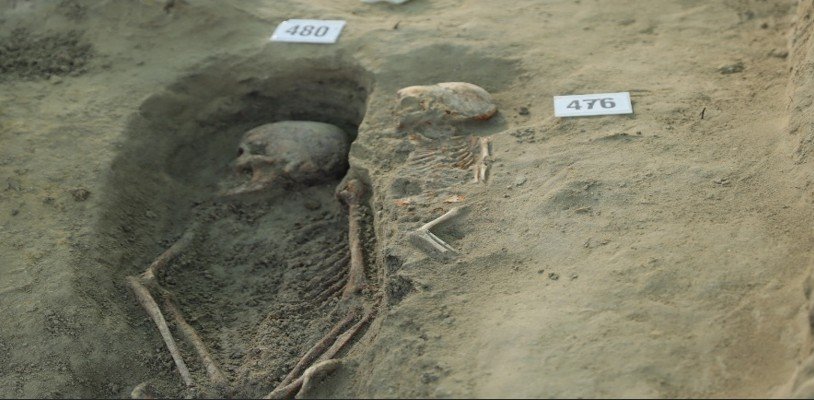
Excavation activities on the 44th day of the third phase of excavations at the Chemmani mass grave were carried out on August 5.
During the day’s excavation, eight newly discovered human skeletons were cleaned and identified.
With this, the total number of human skeletons identified during the three phases of excavations at the Chemmani mass grave has increased to 491. Of these, 489 skeletons have been fully excavated and placed under court custody.
Meanwhile, an administrative discussion was held as an open court session at the Sithupathi Hindu Cemetery premises, where the Chemmani mass grave is located, under the supervision of Jaffna Magistrate S. Lenin Kumar.
The meeting extensively discussed how excavation activities and related procedures should continue.
Officials from the Criminal Investigation Department (CID), Professor Raj Somadeva, the archaeologist responsible for the excavation, Judicial Medical Officer Dr. Selliah Pranavan, representatives of the Jaffna Bar Association, lawyers representing victims and lawyers representing complainants participated in the discussion.
During the session, Professor Raj Somadeva explained the current progress of the excavation and future steps on behalf of himself and the Judicial Medical Officer.
Following discussions, several important decisions were taken.
It was decided that the complete report of the Ground Penetrating Radar (GPR) survey conducted during the second phase of excavations last year, along with scientific explanations, would be submitted to court by Professor Raj Somadeva.
Agreement was also reached to submit a complete report regarding all exhibits and other evidence recovered from the excavation site so far.
After these two reports are submitted to court, detailed discussions will be held on whether further scientific examinations are required to determine the age of the human skeletons recovered during the excavation.
A further court discussion has been scheduled for 14 October.
Meanwhile, lawyers appearing on behalf of the victims made several submissions before court.
They requested that the investigation report prepared by investigators be submitted to court and that all photographs documented by forensic police officers, the archaeological excavation team and judicial medical officers regarding the recovered skeletons be included in the case file.
They further requested that procedures relating to the custody of recovered human remains and exhibits continue under complete supervision and that all pending reports be included as part of the case record.
These submissions were accepted by court.
It was also stated that a decision regarding the fourth phase of excavation would be made based on progress during the final week of the third phase.
Lawyer Ranitha Gnanaraja, appearing for the victims, stated that a decision on whether to proceed with the fourth phase may be taken during the final week of the third phase scheduled for 19 August.
The third phase of excavation has now reached its final stage according to the planned timeline, with forensic, judicial medical and archaeological experts continuing operations under court supervision.