Independent investigation into mass graves essential, says Ana Lorena
01-Sep-2026.
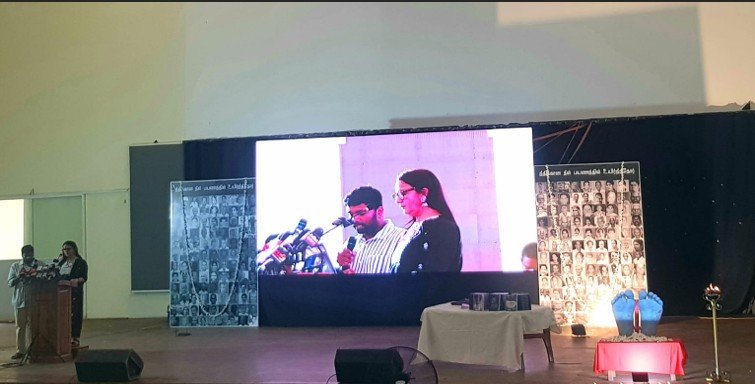
Ana Lorena Delgado Pérez, a member of the United Nations Working Group on Enforced or Involuntary Disappearances, has stressed that it is unacceptable for state authorities to deny the existence of credible and reliable evidence relating to enforced disappearances.
She emphasised that, alongside the ongoing excavation of mass graves, proper investigations must be conducted and appropriate justice must be delivered to the victims.
She made these remarks while attending as a special guest and addressing an event organised by the relatives of the forcibly disappeared at the Thanthai Selva Auditorium in Jaffna on August 30, to mark the International Day of the Victims of Enforced Disappearances.
At the beginning of her address, she thanked the Association of Relatives of the Enforced Disappeared in the North and East for inviting her as a special guest to the event organised to mark the International Day of the Victims of Enforced Disappearances.
She said she hoped the event would bring the international community even closer to the victims.
She also expressed hope that the international conference would contribute towards ending enforced disappearances and demonstrate a committed obligation to find solutions to the grave violations that had already taken place.
She further noted that the resilience of the relatives of the forcibly disappeared was providing encouragement for the continuing journey towards truth and justice.
She said:
"The United Nations Working Group on Enforced or Involuntary Disappearances is one of the important high-level mechanisms established by the United Nations in 1980. The primary objective of this Working Group is to bring an end to enforced disappearances worldwide.
"Enforced disappearance is one of the gravest crimes that can be committed against humanity.
"Accordingly, we are working towards securing justice for victims of enforced disappearances and collecting evidence necessary to establish accountability. In this regard, details of 66,626 cases relating to enforced disappearances have been transmitted to approximately 115 countries. Civil society organisations continue to cooperate with these efforts."
Ana Lorena further said that, unfortunately, enforced disappearances remained a major problem worldwide and that it was unacceptable for state authorities to deny them despite the existence of credible and reliable evidence.
She further said:
"Many people, including civil society activists, journalists, political critics, ethnic and religious minorities and survivors of violations, have been subjected to enforced disappearance in the past.
"Who are the victims of enforced disappearances? Those who have been forcibly disappeared, as well as those directly affected by the disappearances, are victims.
"We are aware of the suffering endured by victims of enforced disappearances every day from the time of their disappearance until the present. We express our solidarity with the mothers of those subjected to enforced disappearance in Sri Lanka.
"There is no systematic record of the number of people who have been forcibly disappeared in Sri Lanka. In the past, our Working Group received more than 12,000 complaints. The majority concerned people who were forcibly disappeared during the Janatha Vimukthi Peramuna (JVP) armed insurgency in the late 1980s and early 1990s.
"They also include cases of enforced disappearance that occurred during the armed conflict between the Government of Sri Lanka and the Liberation Tigers of Tamil Eelam.
"On the journey towards truth, justice and guarantees of non-recurrence, the affected mothers face numerous limitations. Many mothers who fought for justice for a long period have died without receiving an answer. No victim should die in the future without receiving an answer.
"Furthermore, since the majority of those subjected to enforced disappearance were men, the families who depended, or would have depended, on them have suffered severe economic hardship.
"Even under these circumstances, struggles for justice continue through various means. It is moving to see a large number of people coming together and continuing to fight for their loved ones who were forcibly disappeared, and this struggle for justice is important.
"The international community is also emphasising the same point. Proper investigations must be conducted alongside the ongoing excavation of mass graves. Appropriate justice must be delivered to the victims.
"Our Working Group is ready to provide the technical cooperation necessary for this process. The voices of these mothers must continue to be heard by the international community."