Sri Lanka Holds a Special Place in the Hearts of the Vietnamese People: President To Lam in Parliament
09-May-2026.
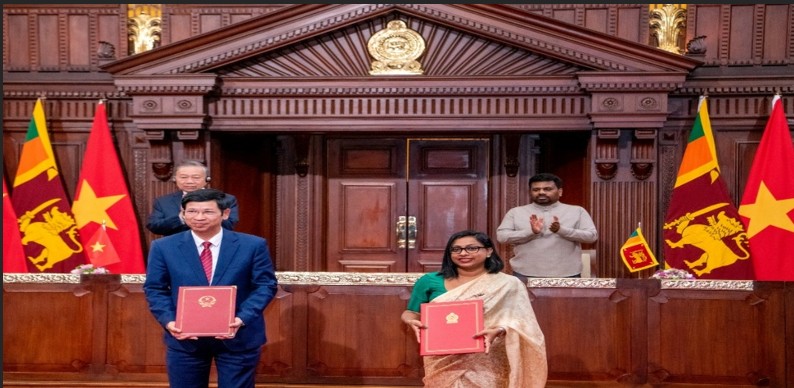
President To Lam of the Socialist Republic of Vietnam, who is also the General Secretary of the Central Committee of the Communist Party of Vietnam, addressed the Sri Lankan Parliament on May 8.
Upon his arrival, he was received by Speaker Dr Jagath Wickramaratne and Secretary General of Parliament Kushani Rohanadeera.
President To Lam thereafter signed the Visitors’ Book and held cordial discussions with the Speaker.
Making history as the first Head of State to address Sri Lanka’s Parliament after 11 years, President To Lam delivered his speech, which was followed by remarks from Prime Minister Dr Harini Amarasuriya and Opposition Leader Sajith Premadasa, both of whom expressed appreciation and extended special thanks.
Full Speech Delivered by President To Lam in Parliament
It is a great honour for me to address today the Sri Lankan Parliament, the supreme legislative body of your country, representing the aspirations, expectations and progress of the people of Sri Lanka. On behalf of the Party, Government and people of Vietnam, I wish to extend my warm greetings and heartfelt solidarity to the Hon. Speaker, Members of Parliament and the entire people of Sri Lanka.
I sincerely thank the Parliament, Government and people of Sri Lanka for the warm and brotherly welcome extended to the Vietnamese delegation. I commend the efforts and achievements of the Sri Lankan Government, Parliament and people in strengthening national stability, economic recovery and development.
With Sri Lanka’s long-standing civilisational heritage, its strategic location in the Indian Ocean, the resilience of its people and the commitment of its leaders, we firmly believe Sri Lanka will continue to move forward in building a peaceful, stable and prosperous nation.
Sri Lanka holds a special place in the historical memories and hearts of the Vietnamese people. President Ho Chi Minh stayed here on three occasions during his revolutionary journey. His statue, unveiled in Colombo in 2013, has become a symbol of the affection Sri Lankan people hold towards the Vietnamese people.
For the Vietnamese people, this is not merely the journey of a national leader in the struggle for independence, but also a natural meeting point between two nations that cherish freedom, peace, humanity and justice. As President Ho Chi Minh once said, “Even if the country gains independence, if the people cannot enjoy happiness and freedom, that independence is meaningless.” This thought strongly resonates with the aspirations of your people for an independent, peaceful and prosperous nation.
Although geographically distant, Vietnam and Sri Lanka share close historical, cultural and developmental aspirations. Both countries have long traditions and uphold compassion, tolerance and unity. Buddhism and Eastern cultural values have contributed significantly towards nurturing morality, peace, brotherhood, collective effort and humanism.
Since the establishment of diplomatic relations on 21 July 1970, our relationship has grown steadily over more than five decades. Last year we celebrated the 55th anniversary of our relations, and President Anura Kumara Dissanayake visited Vietnam and participated in the International Vesak celebrations held in Ho Chi Minh City.
These events reflect that our relationship is not built solely on diplomatic documents, but on mutual understanding and trust between our peoples. Today, I would like to share some reflections on Vietnam’s development journey, particularly the achievements over the past 40 years under the ‘Doi Moi’ reforms.
Forty years ago, in 1986, when Vietnam initiated the Doi Moi reforms, we faced immense challenges: war-damaged infrastructure, a stagnant economy and severe hardship in people’s living conditions. In this context, we chose a new path.
Doi Moi was essentially a new way of thinking. We realised that to develop the country, we must face reality, reform outdated institutional structures, and harness the creativity of the people and the contribution of the private sector.
Accordingly, we transitioned from a centrally planned subsidy-based economy towards a socialist-oriented market economy. The Government plays the role of administrator, guide and facilitator, ensuring the optimal use of resources, respecting market principles and maintaining proper international relations.
Vietnam not only achieved self-sufficiency in agriculture but also transformed from a food-deficit nation into one of the world’s leading agricultural exporters. By opening doors to foreign investment and developing the industrial and services sectors, we integrated into global value chains. While doing so, safeguarding independence and self-reliance remains essential.
Vietnam remains committed to maintaining diversified international relations and being a responsible partner and friend in the international community.
As a result of these reforms, Vietnam has progressed from being among the 20 poorest nations in the world to becoming one of the largest rice exporters and one of the world’s 32 largest economies. By 2025, our GDP reached USD 514 billion, and per capita income surpassed USD 5,000. We have also become an attractive investment destination and have signed more than 20 free trade agreements.
There are many lessons for developing countries. We must safeguard national independence and self-reliance while actively integrating with the world to attract investment and expand trade, and simultaneously build domestic capacity.
Each country must select a development path suited to its own conditions while protecting its legitimate interests. Self-reliance does not mean isolation. It means having the confidence and strength to cooperate with all partners based on equality, trust and respect.
Vietnam considers internal strength as the decisive factor and external resources as an important factor. Internal strength lies in our institutions, culture, traditions, aspirations and creativity of the people. External resources include knowledge, markets, technology, investment and management expertise gained from the international community. Development depends on the combination of these two forces.
While foreign investment is necessary, it alone is insufficient. Infrastructure development, innovation and human resource development are essential for sustainable growth. Vietnam is shifting from growth based on traditional capital and labour to growth driven by science, technology, digital transformation, green transition and high-quality human resources. Strengthening the rule of law, Parliament and national governance is vital in this transformation.
Innovation must begin with thinking. Creative development requires a fair, stable and reliable legal foundation. Parliament must ensure that any new path is illuminated by law, accountability and the will of the people.
Parliament plays a crucial role in institutionalising development actions, enacting laws, making decisions, ensuring competitiveness, monitoring and expressing national aspirations. Speaking before Sri Lanka’s Parliament today highlights the importance of legislative bodies in building trust, implementing reforms and ensuring inclusive development.
Vietnam’s Doi Moi reforms are not only economic policy adjustments but a transformation in how we view development and the roles of the State, market, people and entrepreneurs. Monitoring, evaluation and continuous improvement remain essential, and we continue to advance reforms in a balanced manner.
The key lesson is that development must always keep people at the centre. Development is not merely GDP growth, but improving people’s quality of life, education for children, stable employment, social protection and trust in citizens.
Therefore, we integrate economic growth with social welfare, education, healthcare and rural development. People must not only be beneficiaries but also innovators, participants and stakeholders.
We must understand that the stability of agriculture, farmers and rural areas is crucial for development. Agriculture is not merely an economic sector but the foundation of food security, livelihoods for millions and resilience in cultural crises.
Much of Vietnam’s reforms began with agriculture and rural development. We realised the importance of ensuring farmers’ livelihoods, improving infrastructure, increasing agricultural output, enhancing post-harvest processing and building market brands.
Development today is rapidly changing. Science and technology, artificial intelligence, digital transformation, climate change, supply chain shifts and strategic competition create both opportunities and challenges.
We know that international cooperation can help achieve our goals. Each country has its own history, culture, resources and choices. We wish to share our successes and failures with you, and we appreciate your openness in learning from them.
Looking ahead, we aim to open a new chapter of deeper, more practical and more effective cooperation with Sri Lanka. Based on political trust, traditional friendship and the need to enhance cooperation, I am pleased to announce that Vietnam and Sri Lanka have agreed to elevate relations to a “Comprehensive Partnership”.
This will create favourable conditions to strengthen cooperation in politics, economy, investment, agriculture, education, science and technology and digital transformation. At the same time, we acknowledge challenges such as productivity growth, climate change and digital transformation.
Our key lessons include:
National independence and global integration: attracting investment while building domestic strength.
Rule of law and good governance: transparent legal frameworks are essential, and Parliament plays a decisive role.
People-centred growth: development must be measured by quality of life and happiness, not only GDP.
Agriculture-based stability: agriculture is central to food security and social stability.
Vietnam aims to become an upper-middle-income country by 2030 and a developed high-income country by 2045. We look forward to beginning a new chapter of cooperation with Sri Lanka.
Under the Comprehensive Partnership, cooperation will be expanded in political, security, economic, trade, agriculture and technology sectors.
Key priorities include:
Increasing bilateral trade to USD 1 billion.
Sharing experience in agriculture and food security.
Enhancing cooperation in digital transformation, artificial intelligence and green growth.
Strengthening tourism and Buddhist ties.
Cooperating in international platforms and the United Nations.
Small and medium-sized countries should seek strength through international law, cooperation and good governance rather than conflict. As a nation that has experienced the bitterness of war, we understand the value of peace.
From Hanoi to Colombo, from the East Sea to the Indian Ocean, we share a common belief: peace is our foundation, people are our centre, and development is our goal.
May the Sri Lankan Parliament remain a symbol of the aspirations of the people. May peace and prosperity prevail for the Government and people of Sri Lanka. Long live Vietnam–Sri Lanka friendship. Thank you.