Reusing existing buildings key to climate and housing goals
24-May-2026.
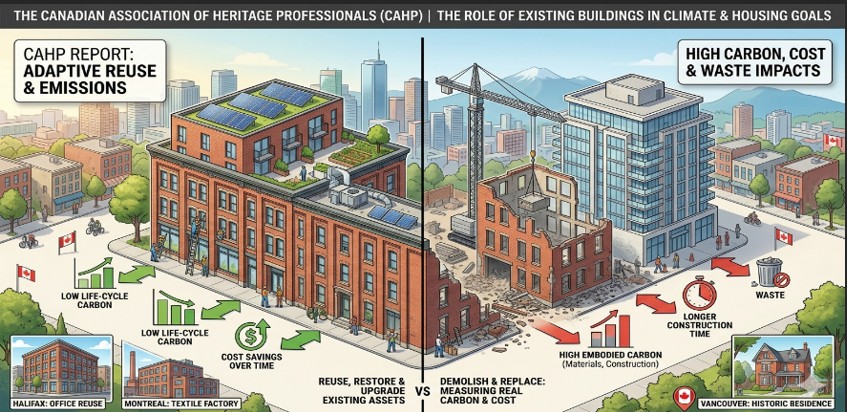
A national report by the Canadian Association of Heritage Professionals (CAHP) highlights that retrofitting and adaptively reusing existing buildings is a highly effective strategy for Canada to meet its climate and housing goals while preserving community character. By conducting life-cycle assessments and cost modeling on three real-world projects—a mid-century office, a textile factory, and a historic residence—the study compared conservation-led renovations against demolition and new-build alternatives. The findings reveal that upgrading existing structures delivers superior long-term carbon and cost benefits, especially when guided by qualified professionals.
The report emphasizes a critical shift in emissions dynamics: as regional energy grids decarbonize, the "embodied carbon" from materials, construction, and demolition represents an increasingly large share of a building's total environmental impact. Because roughly 75% of Canada's current building stock will still be standing in 2050, choosing to reuse rather than replace buildings is vital. Furthermore, retrofit projects are often completed faster, cause less community disruption, reduce construction waste, and stimulate local economies and trades more effectively than new construction.
To fully leverage these benefits, Canadian Association of Heritage Professionals argues that Canada's national policies and building codes must evolve. While current regulations successfully target operational energy efficiency, they largely overlook the carbon costs of manufacturing new materials and demolishing old ones. The report recommends adapting building codes to better account for existing conditions, integrating life-cycle carbon assessments into funding and code approvals, and removing zoning and financial barriers. Ultimately, Canadian Association of Heritage Professionals urges policymakers to treat adaptive reuse as a core strategy for addressing modern challenges like housing shortages, rising construction costs, and underutilized commercial spaces.